
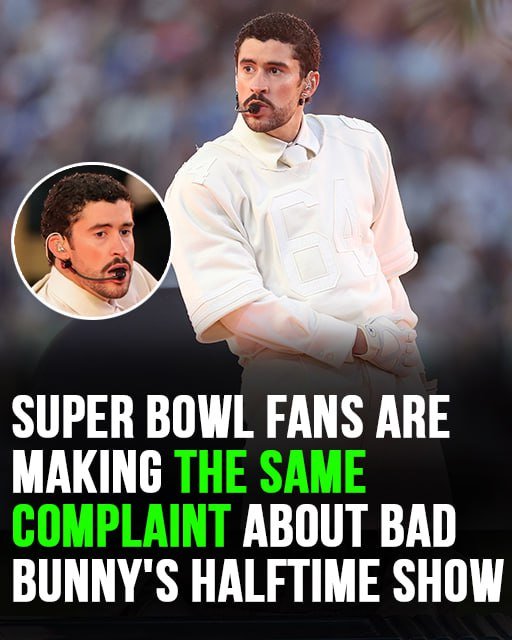
Bad Bunny’s halftime show at Super Bowl LX delivered exactly what many expected: color, volume, movement, and relentless energy. The performance was loud, unapologetic, and designed to dominate one of the biggest stages in entertainment. But as soon as the lights went down and the music faded, a familiar pattern followed. While millions praised the spectacle, a large segment of viewers fixated on the same complaint—and they wasted no time airing it online.
This year’s Super Bowl, held at Levi’s Stadium, already carried more cultural tension than usual before kickoff. From the moment Bad Bunny was announced as the halftime headliner, reactions were sharply divided. Supporters celebrated the choice as overdue recognition of one of the most influential artists on the planet. Critics, on the other hand, framed it as another example of the NFL drifting away from what they consider “traditional” American entertainment.
None of that slowed Bad Bunny’s momentum. By any measurable standard, he is one of the biggest artists in the world. He sells out stadiums across continents, dominates streaming platforms, and has reshaped global pop culture without adjusting his language or identity to make others more comfortable. From a business and relevance standpoint, his selection made perfect sense. If the halftime show is meant to reflect current musical reality, Bad Bunny fits squarely at the center of it.
Yet as the performance unfolded, social media lit up with a familiar grievance. A noticeable number of viewers focused not on the staging, choreography, or star power, but on one specific issue: the language.
One person wrote that they “couldn’t understand anything he was saying” and sarcastically asked whether a translator would be joining him onstage. Another joked about turning on English subtitles, unsure how else they were supposed to follow along. Others were less tongue-in-cheek, questioning why a Super Bowl halftime show would feature music they didn’t personally understand.
Some comments framed the issue as confusion rather than hostility. A few viewers acknowledged Bad Bunny’s popularity but argued that performing entirely in Spanish at an American sporting event felt alienating to them. Others took a sharper tone, labeling the show one of the worst in Super Bowl history and complaining that their children thought the broadcast had switched to a Spanish-language channel.
What stood out was how consistent the complaint was. Across thousands of posts, the issue wasn’t the sound quality, the choreography, or the guest appearance. It was simply this: “I don’t understand the words.”
Supporters were quick to push back. Many pointed out that Super Bowl halftime shows have never required lyrical comprehension to be effective. Performances by artists like Prince, Beyoncé, or Bruno Mars didn’t hinge on viewers parsing every word; they worked because of presence, music, and spectacle. Others noted that English-language songs are broadcast globally every year without concern for non-English-speaking audiences.
Some fans also highlighted the obvious: Spanish is the second-most spoken language in the United States. For millions of viewers, this halftime show didn’t feel foreign at all—it felt overdue. To them, the backlash wasn’t about confusion, but discomfort with seeing mainstream American culture reflect a broader reality.
What this controversy ultimately exposed was less about Bad Bunny and more about expectation. For some fans, the Super Bowl remains a symbol of a narrowly defined version of American culture. Anything that challenges that image is met with resistance, even when it reflects current demographics and musical trends.
Bad Bunny didn’t adapt his sound, his language, or his identity to fit the stage. He brought the stage to his world instead. For supporters, that confidence was the point. For critics, it was the problem.
By the end of the night, the complaints hadn’t overshadowed the performance. Clips circulated widely, streams spiked, and the halftime show dominated conversation long after the final whistle. Whether viewers loved it or hated it, they were talking about it—and in the world of halftime spectacles, that’s often the real metric of success.
Super Bowl LX will be remembered not just for the game, but for a halftime show that forced a familiar question back into the spotlight: who gets to feel represented on America’s biggest stage, and who decides what belongs there.